








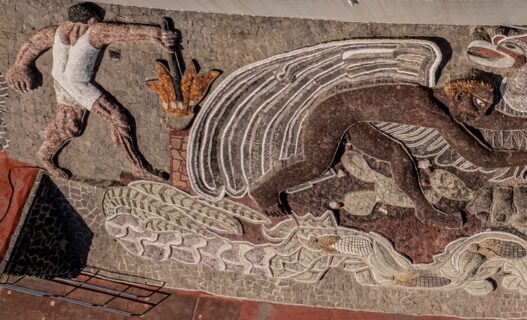
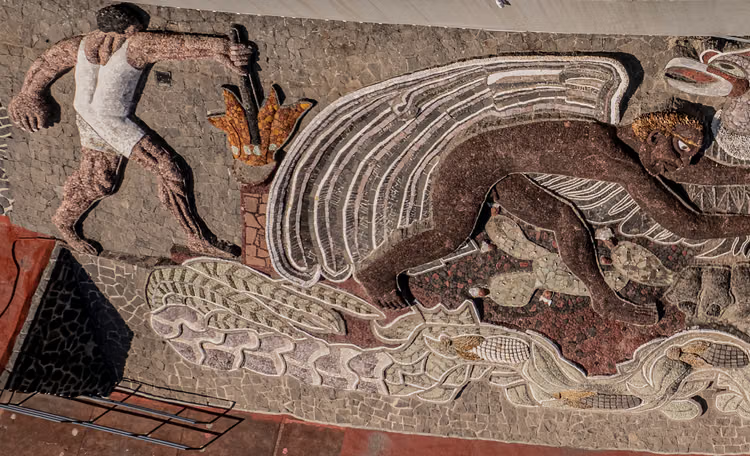
A major restoration project is set to begin on Diego Rivera’s monumental early-1950s stone relief, located on the exterior of the Estadio Olímpico Universitario at the Universidad Nacional Autónoma de México (UNAM) in Mexico City. This ambitious undertaking marks the launch of a comprehensive, multi-year collaboration between the World Monuments Fund (WMF) and UNAM. The initiative aims to preserve and protect several of the most significant public murals across the university’s central campus, ensuring that these masterpieces of mid-century Mexican art survive for future generations. In addition to Rivera’s sculpture-painting, the preservation campaign will address other legendary works on campus, including David Alfaro Siqueiros’s three-dimensional mural on the rectory tower and Juan O’Gorman’s massive stone mosaic on the facade of the university’s central library.
Financial and diplomatic support for the restoration of Rivera’s relief is being provided by the United States embassy in Mexico City. This funding comes through the US Department of State’s Ambassadors Fund for Cultural Preservation Freedom 250 initiative. While the project receives international backing, the actual conservation work will be carried out on-site by highly skilled local experts, highlighting the deep well of restoration expertise present within Mexico.
The Concept of Plastic Integration
The Estadio Olímpico Universitario, completed in 1952, sits at the heart of UNAM’s central campus, which was officially designated a UNESCO World Heritage site in 2007. The stadium is celebrated worldwide as both an architectural marvel and a historic sports landmark. Built directly into a volcanic hollow using local stone, the structure is a prime example of “plastic integration.” Mónica Cejudo Collera, the director of architecture at UNAM, explains that plastic integration is a defining feature of the campus. According to Cejudo Collera, the concept goes far beyond simply placing works of art inside or on an architectural complex; rather, it represents a holistic design philosophy where architecture, art, and physical space are seamlessly integrated into a single cohesive experience.
This artistic approach also represents a pivotal moment in the evolution of the Mexican Muralism movement. Renato González Mello, a leading expert on Muralism from UNAM’s Institute of Aesthetic Research, notes that during this period, mural art transitioned from interior walls to public, outdoor spaces. This shift allowed artists to convey a powerful, utopian message of modernity and national progress directly to everyday passersby.
Rivera’s Innovative Technique and Imagery
Rivera’s relief, titled The University, the Family and Sport in Mexico (created between 1952 and 1954), is a complex “sculpture-painting” that traces the history of sports in Mexico from pre-Hispanic times to the modern Olympic Games. To create this work, Rivera utilized an innovative technique that he developed alongside Juan O’Gorman at Mexico City’s Museo Anahuacalli. The process involved embedding colored volcanic stone, marble, and river stones directly into the sloping masonry of the stadium. González Mello notes that this technique was a major innovation of the era, though Rivera and O’Gorman applied it in distinct ways. Researchers still have much to learn about the specific materials and exact methods used during the construction. In a related development, Diego Rivera’s grandson recently donated more than 150,000 objects to the Museo Anahuacalli, further enriching the resources available to scholars studying the artist’s legacy.
Despite its grandeur, The University, the Family and Sport in Mexico remains unfinished. Rivera’s health began to decline during the mid-1950s, and he also experienced creative clashes with UNAM’s architectural team, leading to the cessation of work. The completed eastern façade of the stadium features a family depicted beneath an eagle and a condor, a direct reference to UNAM’s official crest. Below this imagery, the Mesoamerican feathered serpent deity, Quetzalcoatl, is shown alongside two figures lighting Olympic torches. Those interested in seeing Rivera’s complete vision for the stadium can view his original preparatory sketches, which are currently housed and displayed at the Museo Dolores Olmedo in Xochimilco.
A Long History of Cultural Preservation
The World Monuments Fund has a long-standing history of preserving cultural heritage in Mexico. Since the devastating 8.1-magnitude earthquake that struck Mexico City in 1985, the WMF has completed more than 60 conservation projects at 32 different sites across 17 Mexican states. Caterina Toscano, the WMF’s vice president of development and partnerships, emphasizes that the organization’s renewed focus centers on Mexico’s rich mural heritage, which serves as a continuous historical thread from pre-Hispanic times through the 20th-century Muralism movement. Toscano describes UNAM’s campus murals as a true jewel of modern Mexican architecture.
Stephanie D. Ortiz, the WMF’s regional director for Latin America and the Caribbean, notes that the organization has previously supported major mural conservation efforts in Mexico. These include the restoration of murals inside the Palace of Tepantitla in the ancient city of Teotihuacan, as well as Rivera’s murals at the Ministry of Education building in Mexico City. The current restoration of the Olympic stadium sculpture is strategically timed to conclude ahead of 2028, which will mark the 60th anniversary of the 1968 Mexico City Olympic Games.
Scientific Research and Campus-Wide Restorations
Years of exposure to the elements have left the UNAM murals with varying levels of deterioration, ranging from structural issues to surface damage. The restoration efforts will be carefully managed under the oversight of Mexico’s Centro Nacional de Conservación y Registro del Patrimonio Artístico Mueble (Cencropam). To ensure the highest standards of conservation, a new research seminar led by UNAM experts will be established to study the historical, scientific, and material aspects of each mural before physical work begins. This research phase coincides with preparations for 2027, which marks the 20th anniversary of the campus’s inscription as a UNESCO World Heritage site.
Following the work on Rivera’s relief, the initiative will address other highly vulnerable campus artworks. The most fragile of these is David Alfaro Siqueiros’s three-dimensional mural, The People to the University, the University to the People: For a New Humanist Culture of Universal Depth (1952-56). Located on the rectory tower, this piece has been covered for several years due to severe conservation concerns. Afterward, efforts will turn to Juan O’Gorman’s monumental Historical Representation of Culture (1950-52), a breathtaking 4,000-square-meter stone mosaic wrapping around the university’s central library. As Mónica Cejudo Collera observes, a long-term restoration project of this scale does more than just repair physical damage; it preserves the memory, materials, techniques, and profound meaning of a cultural and architectural legacy that remains deeply relevant today.