









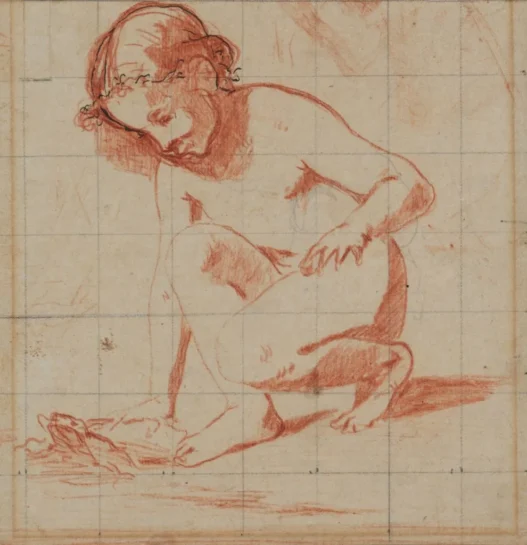
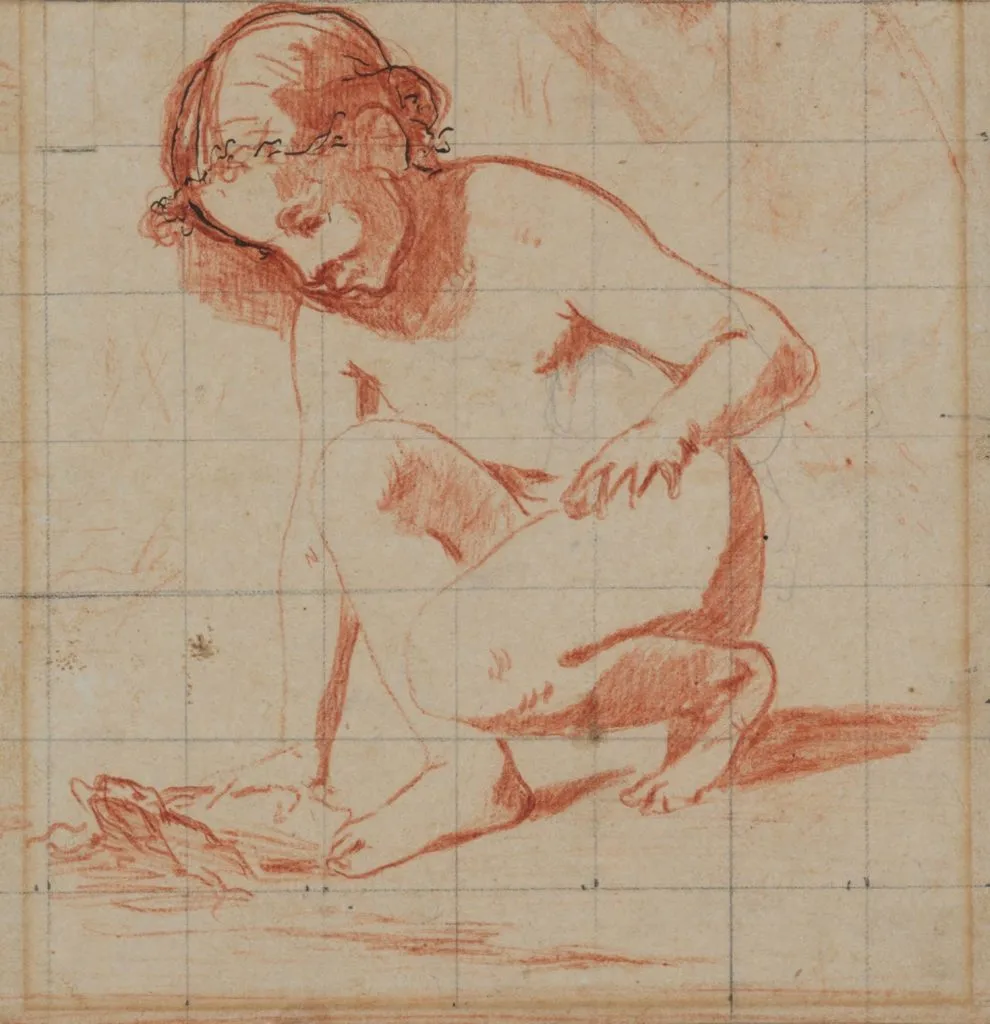
A previously undocumented red chalk drawing of a crouching child has been identified as an early work by French artist Édouard Manet. The drawing was discovered in a private collection in northern Italy after Francesco Baccanelli, a specialist in 17th- and 18th-century Italian painting, encountered it during a visit to the collection.
The work was subsequently examined by Emily Beeny, a specialist in French paintings and drawings and chief curator of the Legion of Honor at the Fine Arts Museums of San Francisco. Beeny and Baccanelli have presented their research in the October issue of The Burlington Magazine.
The attribution is significant because the drawing appears to belong to a period in which Manet was developing his approach to drawing while studying Renaissance art. The work is dated to around 1858–60 and shares characteristics with other red chalk studies associated with the artist.
Manet’s Red Chalk Technique and Renaissance Influences
The drawing demonstrates several features associated with Manet’s early graphic practice. Rather than filling the entire sheet with modeled detail, Manet used areas of unshaded paper alongside carefully developed passages of line.
The drawing also contains refinements in pen and ink, including details in the figure’s hair. Comparable approaches can be found in preparatory drawings connected with major works such as Le Déjeuner sur l’herbe and The Old Musician.
Manet’s interest in Renaissance draughtsmanship was particularly important during his early development. His studies in Italy exposed him to works by Renaissance artists, including Andrea del Sarto. The newly identified drawing appears within this broader context of experimentation with figure studies and historical artistic models.
The Crouching Figure and the Crouching Venus
One of the most notable features of the drawing is the pose of the young figure. The crouching position recalls the ancient Roman sculpture known as the Crouching Venus, a first-century CE work that Manet studied at the Uffizi in Florence.
This connection places the drawing within a larger pattern in Manet’s early practice: the transformation of historical and classical models into studies for his own artistic work.
The identity of the figure remains uncertain. According to the research by Beeny and Baccanelli, the facial features resemble those of Alexandre, a young studio assistant who worked for Manet in the late 1850s and occasionally posed for the artist. At the same time, the figure appears to be a young girl, making a definitive identification impossible at present.
The uncertainty surrounding the sitter is part of what makes the drawing particularly interesting from an art-historical perspective. Rather than functioning solely as a portrait, the work may have been primarily concerned with pose, form, and the development of a larger composition.
A Preparatory Study for a Lost or Unfinished Composition?
The drawing is squared with a graphite grid. This technical feature is important because such grids were commonly used to help artists enlarge a preliminary design and transfer it onto another surface.
However, the crouching figure does not appear in any known surviving Manet painting. This raises the possibility that the drawing was created for a composition that was never completed, altered substantially, or subsequently lost.
One possibility proposed by the researchers is that the drawing may have been connected with The Finding of Moses, a major unfinished project Manet worked on during the late 1850s. The painting was eventually cut down and transformed into The Surprised Nymph, completed in 1861.
The connection remains a hypothesis rather than an established identification. No surviving Manet composition currently provides a definitive destination for the crouching figure.
The Faint Studio Stamp Provides Crucial Evidence
One of the most important pieces of evidence supporting the attribution is not immediately visible under normal lighting.
Ultraviolet examination revealed a faint “E.M.” studio stamp in the lower-right corner of the sheet. Its shape, dimensions, and color correspond to stamps found on other drawings associated with Manet.
This technical evidence strengthens the stylistic attribution. The drawing’s handling of light and shadow, its treatment of the figure, and its distinctive details can be considered alongside the physical evidence provided by the studio stamp.
The combination of stylistic characteristics and material evidence is particularly important in the study of historical drawings, where attribution can depend on multiple forms of analysis rather than a single identifying feature.
A Drawing with a Complex 20th-Century History
The drawing’s recent rediscovery does not mean that it has been hidden from collectors for centuries without documentation. Research into its provenance has revealed that the work was sold twice during the 1930s, first in Germany and later in Switzerland.
It was eventually acquired by its current owner from a collection in Brescia, Italy, in 1996. Despite this history, the drawing had not entered the major scholarly literature on Manet before its recent examination.
The work is therefore notable not only for its possible place within Manet’s oeuvre but also for the way it demonstrates how drawings can remain outside established art-historical records even after passing through the European art market.
What the Discovery Adds to Manet Scholarship
The rediscovered drawing offers another example of the importance of drawing to Manet’s artistic development. His preparatory studies reveal how he investigated poses, figures, historical references, and compositional possibilities before or alongside his work on paintings.
Its relationship to The Old Musician, Le Déjeuner sur l’herbe, and Manet’s studies of Renaissance and classical art provides a useful framework for understanding the artist’s early working process.
At the same time, several questions remain unresolved. The identity of the sitter has not been established, the original purpose of the drawing is uncertain, and no surviving painting has been conclusively identified as its intended destination.
The researchers hope that the drawing will be included in a future edition of Manet’s catalogue raisonné, where its attribution and place within the artist’s known graphic work can receive further scholarly consideration.
For now, the study of the crouching child remains both a newly recognized work and an unresolved piece of Manet’s early artistic history. Its rediscovery demonstrates how previously undocumented drawings can complicate and expand our understanding of an artist whose major paintings have long occupied a central position in the history of modern art.