








A newly identified cuneiform tablet fragment discovered at Hattusa, the ancient capital of the Hittite Empire in central Türkiye, has been confirmed as part of a copy of the Kadesh Peace Treaty, one of the most important diplomatic agreements preserved from the ancient Near East.
The fragment was uncovered during archaeological excavations at Büyükkale, the fortified royal area of Hattusa in Çorum. Scientific examination carried out over approximately one year established that the damaged tablet fragment belongs to a Hittite version of the treaty concluded between Hittite King Ḫattušili III and Egyptian Pharaoh Ramesses II.
What Is the Kadesh Peace Treaty?
The Kadesh Peace Treaty was a diplomatic agreement between the Hittite Empire and ancient Egypt following decades of conflict between the two powers.
The treaty is associated with the aftermath of the Battle of Kadesh, a major confrontation between the forces of Ramesses II and the Hittite king Muwatalli II. The subsequent peace agreement between Ramesses II and Ḫattušili III established a framework for peace and cooperation between the two states.
The surviving treaty tradition is particularly significant because it provides evidence of a formal diplomatic relationship between two major powers of the Late Bronze Age. The United Nations describes the treaty as the oldest known peace treaty and notes that the original clay-tablet version dates to approximately the 13th century BCE.
New Hattusa Tablet Fragment Reveals Refugee Provisions
The newly identified fragment adds information to the surviving Hittite copies of the treaty.
According to Türkiye’s Ministry of Culture and Tourism, the readable portion concerns provisions dealing with people who fled one kingdom and sought refuge in the territory of the other. The fragment corresponds to provisions associated with Articles 12–20 of the treaty.
The surviving lines refer to people fleeing from Egypt and Hatti, the name used for the Hittite kingdom, and include provisions concerning the treatment of these individuals. The text also contains references to homes not being destroyed.
Because the fragment is incomplete and damaged, researchers cannot reconstruct the entire passage from this discovery alone. Nevertheless, its identification provides an additional piece of evidence for understanding the structure and contents of the Hittite version of the Kadesh Peace Treaty.
Why the Hattusa Discovery Matters
The discovery is important because the Kadesh Peace Treaty survives in multiple textual traditions and fragments, rather than as a single complete ancient document.
The Egyptian version was recorded in hieroglyphic inscriptions on temple walls in Egypt, while fragments of the Akkadian cuneiform version have been found at Hattusa. Earlier discoveries are now held in several museum collections, including the Istanbul Archaeological Museums, the Museum of Anatolian Civilizations, the Vorderasiatisches Museum in Berlin, and the Hermitage Museum in St. Petersburg.
The newly identified fragment therefore contributes to an ongoing effort to reconstruct the Hittite cuneiform version of the Kadesh Treaty.
Hattusa and the Hittite Empire
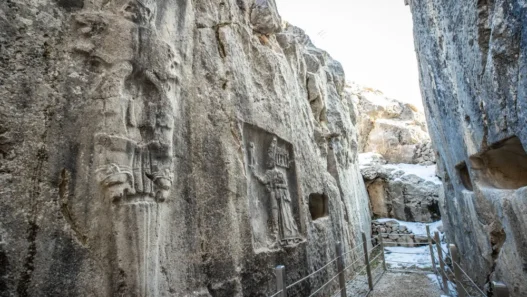
Hattusa was the political and administrative center of the Hittite Empire, one of the major powers of the ancient Near East during the Late Bronze Age.
Located in present-day Çorum Province in central Türkiye, the archaeological site contains monumental temples, fortifications, royal buildings and extensive archives of cuneiform tablets.
Büyükkale, where the new fragment was discovered, formed part of the fortified royal center of ancient Hattusa. Archaeological work at the site has produced important evidence for Hittite political, religious, administrative and diplomatic history.
The discovery of another fragment connected to the Kadesh Peace Treaty demonstrates the continuing importance of archaeological excavations at Hattusa for the study of ancient diplomacy.
What Does the Fragment Say About Ancient Diplomacy?
One of the most notable aspects of the newly identified text is its treatment of people who crossed political boundaries.
The provisions concerning people fleeing one kingdom for another show that the treaty addressed more than simply the cessation of military hostilities. It also established rules concerning the movement and treatment of individuals between the territories of the Hittite and Egyptian states.
The fragment therefore provides additional evidence for the legal and diplomatic mechanisms developed between the two kingdoms.
Rather than representing peace solely as the end of warfare, the treaty can be studied as a broader framework governing relations between two states.
The Search for More Kadesh Treaty Fragments Continues
The newly identified tablet fragment does not complete the Hittite version of the treaty. Significant portions remain damaged, missing or dispersed among different archaeological and museum collections.
Researchers working at Büyükkale hope that further excavations may reveal additional fragments of the treaty or related texts. Each newly identified piece could help scholars reconstruct the ancient document more accurately and better understand Hittite-Egyptian diplomacy.
The discovery also highlights the continuing archaeological significance of Hattusa, where excavations have been producing cuneiform documents and architectural remains for more than a century.
A New Piece of the World’s Ancient Diplomatic Record
The identification of the Hattusa cuneiform fragment as part of a copy of the Kadesh Peace Treaty adds another piece to one of antiquity’s most important diplomatic records.
Found in the former Hittite capital, the fragment preserves provisions concerning people who crossed the borders between Hatti and Egypt and provides further evidence of the complex relationship established between the two powers.
More than three millennia after the agreement was concluded, archaeological research at Hattusa continues to reveal new information about how ancient states negotiated peace, managed borders and regulated relations between their populations.